Lourdes
emilia verginelli
Theatrical genre Prose Performance
Directing: Emilia Verginelli
Dramaturgy: Emilia Verginelli
Actors: Emilia Verginelli e Dario Costa
Other credits: by and with Emilia Verginelli,
and with Dario Costa, letterari counseling Sara De Simone, soundscape Francesca Cuttica, light Camila Chiozza
production Bluemotion
special thanks to Roberta Luciani, Viola lo Moro, Andrea Pizzalis, Naoures Rouissi, Filomena Fusco, Vincenzo Rilletti, Benedetto Patruno, Ubaldo, Gianni, Alessandro, Andrea Beghetto, Luisa Merloni, Elisa Alessandro, Elena Bastogi, Benedetta Boggio, Giorgina Pi, Lucia Calamaro.
translations by Brianda Carreras, Alexia Sarantopoulou, Elise Blotière, Tomasz Kireńczuk, Naoures Roussi, Neon Loriga, Yan Duyvendak
LIS interpretation Edgarda Samaritani
artistic encounters by FONDO Yan Duyvendak, Camille Louis, Ana Pi
project sustained by FONDO Network for emerging creativities.
© Claudia Pajewski
Among the winners of Progetto CURA 2022 Elsinor Centro di Produzione Teatrale / Teatro Cantiere Florida (Firenze) + Cross residence (Ameno, Verbania)
residencies (2020-2023) Teatro India - Teatro di Roma (Roma), fivizzano27 (Roma), KRAKK (Santarcangelo di Romagna), Ateliersì (Bologna), Angelo Mai (Roma), Centrale Fies (Dro), AMAT e Teatri di Pesaro (Pesaro), Teatro Nuovo (Napoli), Teatro Pubblico Pugliese (San Vito dei Normanni)
Key words: performance, sacro, condivisione scenica , accessibilità, collettività
Production: Bluemotion
Year of production: 2023
Theatrical genre: Prose Performance
Lourdes is the story of an encounter, of some encounters. It is the story who has and has never been to Lourdes. Someone imagines it, someone else hates it, another would have wanted to go there to ask for a miracle. It is a conversation, a series of dialogues happened over time, not in a chronological order though it is an order that swings from storytelling to remembrance, from remembrance to a reflection that stays in presence of scenical representation. A research of the border between self and other(s). Within the fragmentation of a shared space, without center nor frontality, choice about which questions are to be raised is left to anyone.
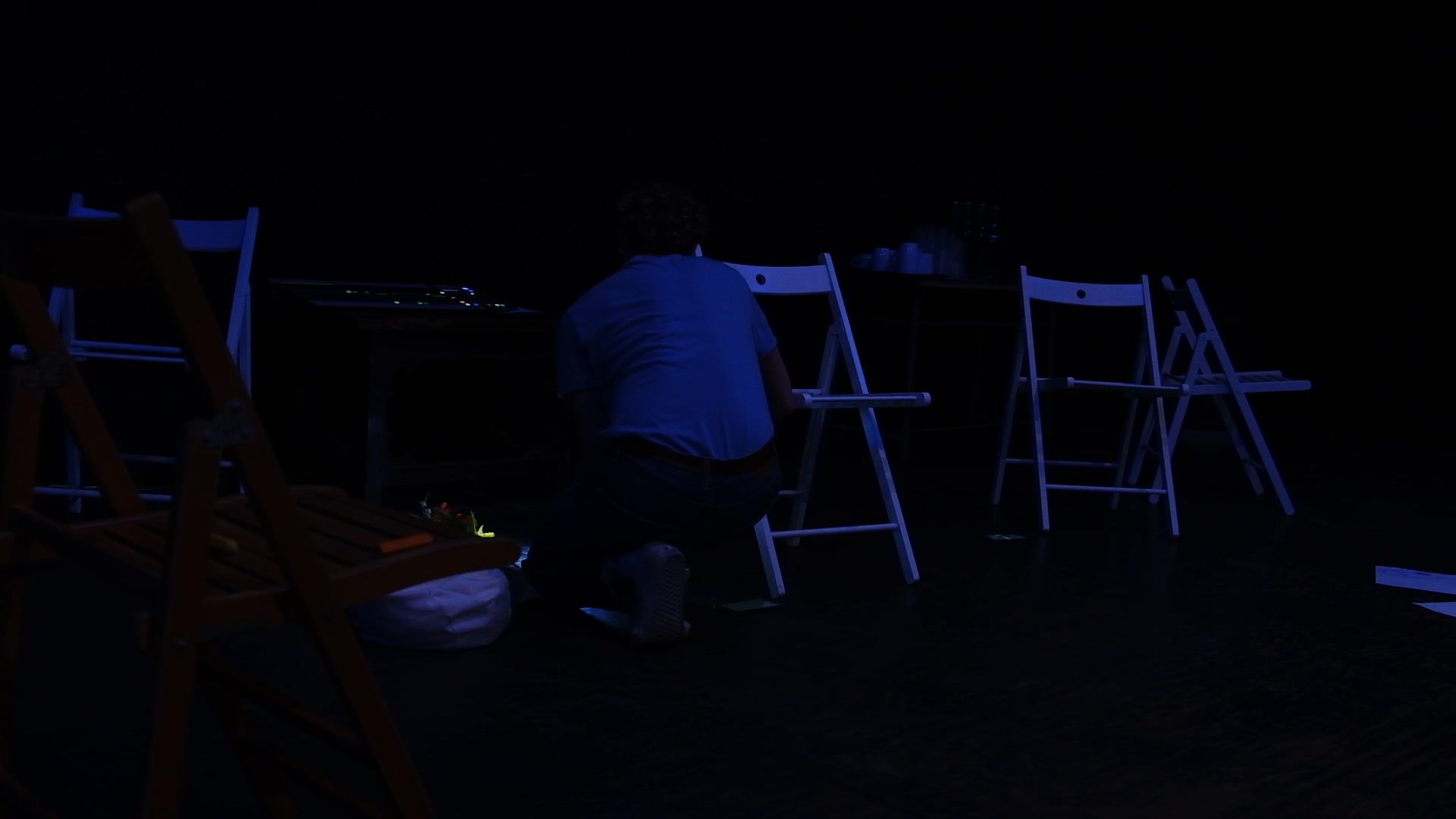
Lourdes is a scenic sharing conceived for a small audience, that takes place in a dilated and repeated time articulated not only by the performers but by the audience it self. Lourdes asks its audience to inhabit the theatrical and performative space, which is not only stripped from the frontality of the center stage, but has also at its core the will to nullify the centrality of the performer as the center of attention and visual focus, to dislocate eyes and hands in other directions, thus resetting this theatrical hierarchy. What we want to offer to the audience is the possibility to escape from the role of those who observe, but to actually participate in the scenic state in all its entirety. Apart from being able to place them selves as they like (you could stay seated, exchange seat, lay on the floor, stand and walk around, actively deciding where to lay your eyes )the audience is invited to interact with numerous stage props, which are nothing more than the tools that were used during the research process and creation of Lourdes: pencils and markers, paper sheets, the books on which we studied, and other things. This potential distraction is, for us, an entry door to a new way of inhabiting and participating in a theatrical space, as the audience establishes itself as a sort of temporary and everchanging community. Another fundamental element is the transcript of the spoken parts, that is displayed on numerous smartphones scattered all over the stage, and that can be consulted at will by the audience. Apart from being an accessibility tool for hearing impaired people, non-italian speakers or for those who have a difficult time keeping their focus, this performative dissemination removes even more the performers from their theatrical centrality, granting the audience the possibility to be part of this sound immersion without ever looking at the performers.
The dialogues that we hear explore the theme of the search for transcendence as seen through the experience of faith, its elusiveness is represented through the fragmentation of this way of thinking the theatrical space. This same search begs the question of how a stage can be experienced by bodies and if in this sharing there is the possibility of shifting the focus on the search for transcendence through the experience of community, care, trust
Information reserved for Organizers
Non è stata caricata nessuna recensione
Information reserved for Organizers


